The crankset is the power center of the bicycle. Parts are designed
to transmit power from human pedaling to the drivetrain. Thus
cranksets must be efficient in energy translation and at the same
time support the weight of the driver when standing, or maybe
if you persist in bunny hopping… when landing. So buying
quality bicycle components, crank arms, chainring and bottom bracket
is essential to enjoyable riding. But what is quality?
First it might be important to know what makes up the most common
crankset since the number of configurations and combinations is
growing at an exponential rate.
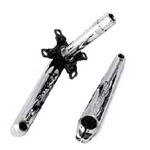 Cranks
Arms: This is the essential arm connecting the bicycle
pedals to the spindle or axle. There is a left crank arm and a
right crank arm, with the later often sold in combination with
your front sprockets (chainring) and spider.
Cranks
Arms: This is the essential arm connecting the bicycle
pedals to the spindle or axle. There is a left crank arm and a
right crank arm, with the later often sold in combination with
your front sprockets (chainring) and spider.
Spider: These are the star shaped
arms that radiant out from the right crank to hold the front sprockets
or "chainring." They can be independently bolted to
the right crank arm or forged as a one piece integrated crank
arm-spider combination.
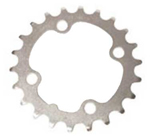 Chainring:
A fancy name for the front sprockets. Different manufacturers,
just like cars, design them with various bolt patterns so it is
essential to identify what specifically will work with your crankarm-spider-spindle
combination and front derailleur.
Chainring:
A fancy name for the front sprockets. Different manufacturers,
just like cars, design them with various bolt patterns so it is
essential to identify what specifically will work with your crankarm-spider-spindle
combination and front derailleur.
Bottom Bracket Shell: This is
the tube welded to the lowest point of your bicycle frame designed
to accept a set of bearings and the main spindle (bottom bracket
assembly). It is typically threaded to accept the bottom bracket
assembly. English, French and Italian bikes are NOT all the same
diameter or threaded with the same tpi (teeth per inch) thus it
is important to get the right match. It is not really part of
the chainset, but you must know its specifications in order to
replace any components.
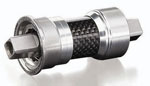 Bottom
Bracket Assembly: This bicycle part comes in numerous combinations
and configurations, but essential includes the drive spindle,
a set of bearings and cups that thread into the shell to hold
all of these parts in place. This assembly allows the pedals to
freely rotate and put power to the chain.
Bottom
Bracket Assembly: This bicycle part comes in numerous combinations
and configurations, but essential includes the drive spindle,
a set of bearings and cups that thread into the shell to hold
all of these parts in place. This assembly allows the pedals to
freely rotate and put power to the chain.
Spindle: The drive axle. It
comes in a number of different configurations depending on the
attachment link between crank and spindle. It may or may not come
independent of the bearing assembly. In two piece cranksets the
spindle is attached to the right crank arm. In these cases the
bottom bracket bearings and cups are sold separately to match
spindle diameter & length.
The Crankset Unit:
Where buying a complete crankset becomes confusing is that these
key 7 pieces (2 cranks, spider, chainrings, spindle, retaining
cups and bearings) are not always sold in the same way or have
one set of sizes.
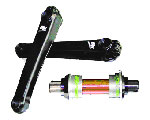 Today
most mid-range bikes consist of a sealed bottom bracket assembly
with spindle, sold with matching cups for installation and a separate
set of crank arms that match the end profile of the spindle for
correct mounting. A list of chainring options is added to complete
the chainset. This is considered to be a 3 piece crankset.
(2 cranks and one cartridge style bottom bracket)
Today
most mid-range bikes consist of a sealed bottom bracket assembly
with spindle, sold with matching cups for installation and a separate
set of crank arms that match the end profile of the spindle for
correct mounting. A list of chainring options is added to complete
the chainset. This is considered to be a 3 piece crankset.
(2 cranks and one cartridge style bottom bracket)
Current innovations in bicycle componentry have fused the right
crank arm to the axle and pre-mounted the matching spider-chainset
combination, creating a 2 piece crankset. (they don't really
include the bearing assembly as part of the story) (shown in top
picture above>
The appropriate sleeve with sealed bearings is threaded into
the bottom bracket shell and the right crankarm-spindle combination
mounted through these bearings. The left crank arm is mounted
on the opposite end of the spindle.
The Campagnolo
Centaur Ultra-torque Crankset has taken the conversation one
step further splitting the axle at the mid point inside the bottom
bracket shell to offer significant weight advantages over traditional
solid spindle models.
Read further on this site for information on why and how bicycle
parts suppliers and manufacturers continue to tweak these
designs for weight, durability and speed gains.
