For a seat to be classified as the best bike saddle it must exactly
cradle your two hard seat bones and not exert pressure on the
soft tissue in between. It is these bones that must absorb your
body weight on long rides. Periodic standing will allow the legs
and somewhat the arms to relieve the butt for short periods, but
predominately it is the butt that must develop callouses for the
long haul.
A bike seat is designed in one of two ways. Either a one piece
molded frame with padding applied to the surface or a with leather
stretched over a metal frame and held in place with rivets.
Metal Frame: The metal frame of your bike seat serves
two purposes; to support the actual shape of the seat and to allow
it to be mechanically attached to the seat post. It is typically
steel or titanium. Better steel frames are chromed for more rust
resistance. Brooks bike saddles use titanium rails for lighter
construction.
Not all rails have sufficient adjustment with all seat post designs,
pushing the bicycle saddle too far forward, thus you might chose
to bring your bike with you when shopping so that you can test
each seat in combination with your seat post and bike frame.
 Saddle
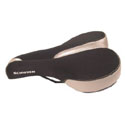
Base: over the metal frame is mounted a plastic base that
is designed to be flexible under the riders weight, often with
a hole in the middle, like someone split your seat in two. In
theory it was designed to remove pressure from your more private
parts. For some riders this has proven to be less comfortable
as the edges around the perimeter of the hole have added to the
discomfort.
Saddle
Base: over the metal frame is mounted a plastic base that
is designed to be flexible under the riders weight, often with
a hole in the middle, like someone split your seat in two. In
theory it was designed to remove pressure from your more private
parts. For some riders this has proven to be less comfortable
as the edges around the perimeter of the hole have added to the
discomfort.
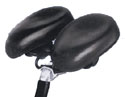 Other
versions of the same story, have created a dual pad saddle...
one seat pad for each cheek :) Some guys I talk to swear by the
product and others swear AT the product, so it really is NOT a
one shoe fits all. I can't give you the perfect answer as to what
will be best for your body.. you really have to get out and try.
Other
versions of the same story, have created a dual pad saddle...
one seat pad for each cheek :) Some guys I talk to swear by the
product and others swear AT the product, so it really is NOT a
one shoe fits all. I can't give you the perfect answer as to what
will be best for your body.. you really have to get out and try.
Saddle Padding: First I'll suggest that saddles with excessive
padding are the most common cause of painful chafing of the inner
thigh.. the bulk becomes a rub point after the first half hour..
And the softest is most often not the most comfortable to cycle
on. Thus try a range of options NOT just the seats that look the
most cushy in the bike shop!
A GEL bicycle seat uses a special high tech form of closed-cell
foam for cushioning. It is effective, as with the gel in you bike
gloves and padded
bicycle shorts, but again it does not breath... As with all
life there are tradeoffs.
Saddle Cover: The best bike seat covers are smooth enough
to be comfortable, but textured enough so you are not always sliding
off, particularly in wet weather.
- Vinyl: Least expensive choice, designed to look like leather,
but doesn't breath. Tends to be a little slippery and in its
cheapest form wears easily on the corners
- Lycra©: breathable, dries fast but doesn't always wear
as well as I might like it to.
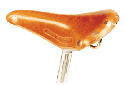 Real
leather: Leather is riveted to the metal frame and molds to
your body shape (at least after a few miles) without the need
for additional padding, this lack of foam makes it more breathable.
Does tend to be a little heavier and the leather, as with fine
boots does require some attention for it to survive particularly
the challenges of wet weather. Typical recommendation is to
coat it with Proofide© (or similar leather lubricant) every
3 months on both the top and underside and then let it sit in
the sun to encourage penetration. (fenders will help to keep
the moisture off the underside) Thus leather saddles are more
work.
Real
leather: Leather is riveted to the metal frame and molds to
your body shape (at least after a few miles) without the need
for additional padding, this lack of foam makes it more breathable.
Does tend to be a little heavier and the leather, as with fine
boots does require some attention for it to survive particularly
the challenges of wet weather. Typical recommendation is to
coat it with Proofide© (or similar leather lubricant) every
3 months on both the top and underside and then let it sit in
the sun to encourage penetration. (fenders will help to keep
the moisture off the underside) Thus leather saddles are more
work.
Leather seats also require some adjustment. As with all leather
it stretches with use and weather, thus they are typically designed
with a tension bolt at the nose of the saddle. This is a drag
though if you think you may need to be tweaking it on the road..
more tools, more weight!
Weight:The lighter the better if you are hauling your
bike up alot of long hills.
EXTRA'S
Return Policy: I'd definitely not buy, especially an expensive
seat, if I didn't have the ability to return it within a reasonable
amount of time. It is next to impossible to know if it will work
with your body without taking it out on the road for a couple
of long hauls.. one reason to support your local dealer. Try a
few before you make the final decision.
Tools: Make sure if the seat uses special wrenches for
either attachment or adjustment that they either come with the
saddle or you are able to purchase them independently
Bike Seat Covers: There are quite a few of aftermarket
pads or gel seat covers that are intended to be added to the top
of your bike saddle. I'd suggest they are usually a waste of time.
If your existing seat does not fit your body, it is highly unlikely
that adding a gel pad is going to turn it into the best bike saddle...
put the money out and just get yourself a new seat.
